On the possibility of infiltration
Joyce Joumaa speaks to Caroline Honorien about the generative space between failure and reconfiguration.
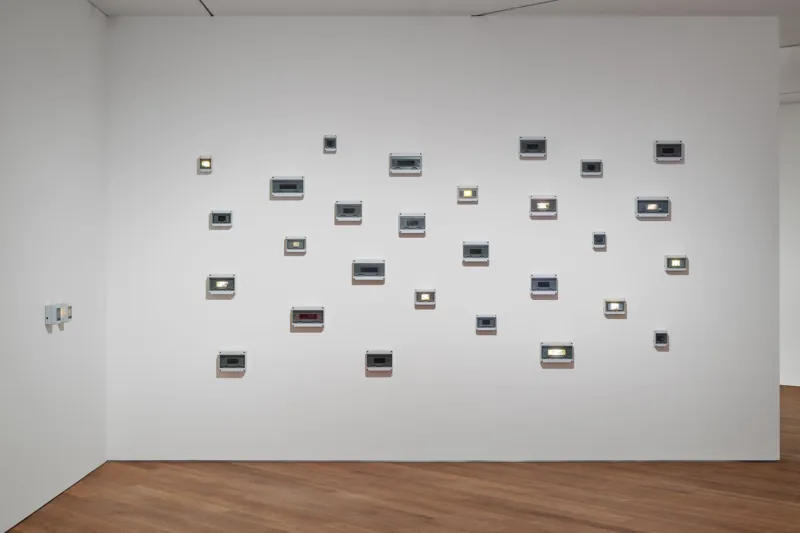
Caroline Honorien: To begin, I want to bring in Ralph Ellison’s Invisible Man (1952). Its narrator, a Black man whom society refuses to see, responds by wiring his basement with 1,369 lights: illumination becomes a way of asserting his presence, but also an act of sabotage. Ellison describes the junkman who supplies him with wire and sockets as ‘a man of vision’. I am interested in that figure: someone whose improvisation is both a means of survival and a form of resistance. Your installation Periodic Sights, for which you received the Baloise Art Prize at Art Basel in 2025, and which was recently acquired by Mudam and is currently on view at the museum, seems to trace a related shadow infrastructure in Lebanon through junction boxes, generators and forms of collective ingenuity born out of necessity. How did this work come about?
Joyce Joumaa: I’ll begin with some context around this work, and what was happening in Lebanon at the time I was thinking about it. In 2019, there was a very disturbing financial collapse: the Lebanese currency was devalued and from one day to the next, people lost their money. I became interested in the material aspects of this crisis and how they translated through different phenomena. Then, in 2020, there was the Beirut port explosion, which added further layers to that collapse. One of the phenomena generated by this situation – and I use the word collapse precisely to anchor these infrastructural problems within a larger crisis – was the complete degradation of the national electricity grid. Historically, Lebanon already had a very weak national grid, but with everything I’ve just mentioned, the government could no longer buy diesel and therefore could no longer supply the electricity we received at home.
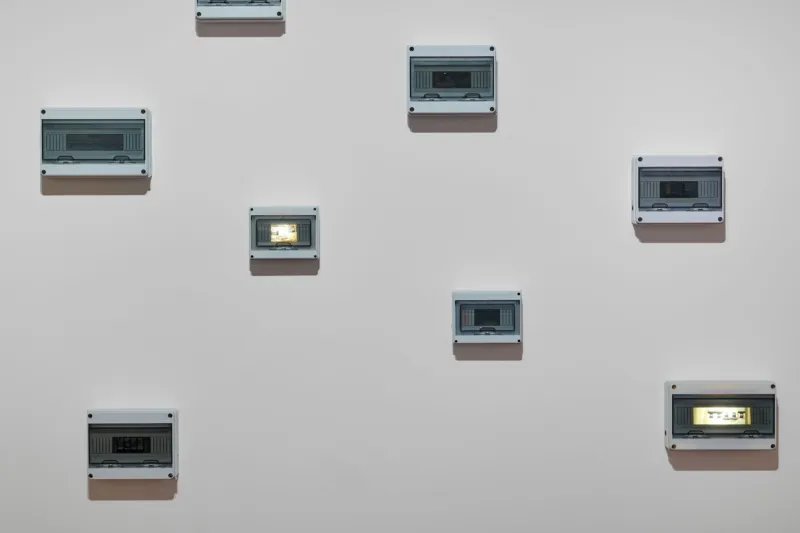
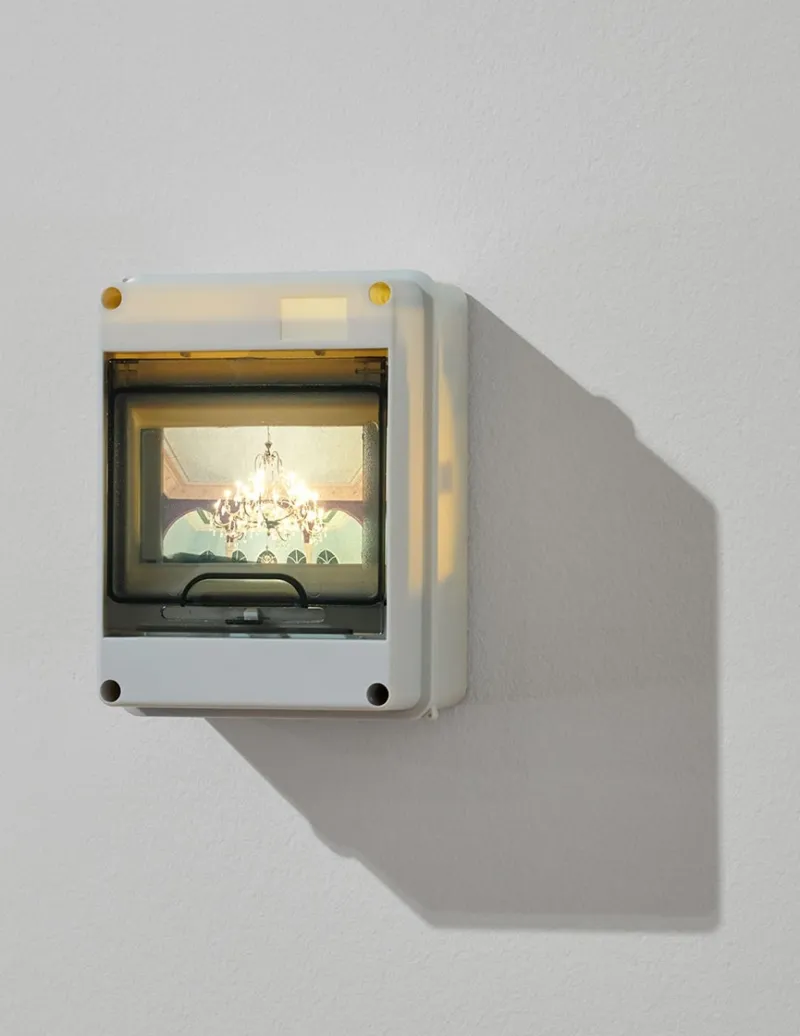
I started observing how people, including in my own household, interacted with circuit-breaker boxes, which we call disjoncteurs. Because the electricity supply was so fragile, people had to go to these boxes every day to switch the power on and off. It became a kind of daily routine. For this work, I decided to use the prefabricated boxes usually used to install circuit breakers. I appropriated the space of the switches with photographs I had taken in Lebanon. They aren’t necessarily staged images; they are photographs of the mundane, of domestic spaces and everyday situations, sometimes directly referring to light and sometimes not.
I installed the photographs in these boxes, with a light behind them that followed the electricity schedule of each building in Lebanon. The solution people had arrived at was that each building or neighbourhood had its own electricity schedule: you knew that from one hour to the next the power would be on, and then it would be off. The whole of everyday life became orchestrated around this schedule. That was what I found interesting.
CH: Yes, and with this organisation, and the failures that followed the collapse, there seems to be a kind of blurring: ingenuity shades into failure, and failure into questions of corruption. How do these dynamics emerge in the material you’ve been working with? And can you speak more generally about the conditions that allow this blurring to take place?
JJ: Given the age I was when the crisis began – and I should stress that it has not ended but continues to this day – it was the major political and sociopolitical event in Lebanon that I had witnessed and that affected me so deeply.
This is not the only work I made in response to the crisis. Earlier, I made a film called To Remain in the No Longer (2023), an experimental documentary about Oscar Niemeyer’s failed modernist project in Tripoli. My interest in failure really began there: looking at that project as a way of understanding failure, not as something to fetishise – simply saying, ‘It didn’t work, so here is a work about how it didn’t work’ – but as a way of understanding how the corrupt infrastructures that govern the state of things in Lebanon infiltrate the mundane, and how we enter into dialogue with them in their failed state.
There is also something about failure, or the idea of ingenuity that you bring up, that I find interesting. When things fail, they require a certain state of reconfiguration. I’m very interested in that space between failure and reconfiguration, and in what happens between those two processes. Reconfiguration can offer new potentials – not necessarily romantic or positive ones, but potentials that force us to deal with a situation differently. It is in the emergence of those possibilities that failure becomes interesting to me.
Reconfiguration can offer new potentials – not necessarily romantic or positive ones, but potentials that force us to deal with a situation differently.
CH: And in terms of the conditions that enable corruption, could you expand on that in relation to Lebanon’s colonial and postcolonial history?
JJ: To return briefly to the historical failure of Lebanon’s electricity grid: when I was researching Électricité du Liban, I found that there had been numerous concessions between the Lebanese and French governments, and that France retained significant shares in the company even after independence. This is, of course, not unusual within the postcolonial dynamics that persist after formal independence. I wouldn’t necessarily say that this is a work through which I’m attempting to offer a decolonial perspective, because I don’t think its language is fully able to engage with and translate that. But underlying this question of corruption, there is certainly a colonial history that one could consider or point towards.
CH: Another interesting aspect of Periodic Sights is that it appears to be a static object, yet it performs duration. What drew you to that tension? And more broadly, how do you think about the intersection of video and sculpture?
JJ: The duration you mention is very intrinsic to the state of things the work emerges from: this schedule that resulted from a kind of collective, co-organised response. I felt the work had to follow that proposition. For the sake of the experience, I could have made the cycle shorter so that a museum audience could encounter it immediately, but I think the work translates more fully by engaging with that duration.
The question of video is interesting because, when I was making these works, I was of course thinking about their sculptural aspect. Sculpture is perhaps something I haven’t explored as much in my practice more broadly, but I’m very interested in the political affect of objects – objects that imply a particular political dimension or charge. To me, these objects do that.
At the same time, I don’t necessarily deny that they can be understood as videos, even though they are still photographs. They pertain to the fundamental elements of video: time, light and image. Arguably, that is also what cinema and video are. So I think one could read them as videos.
CH: I wanted to take a moment to consider sound, both in this work and more broadly in your practice. Often, sound seems to function as a form of interference, whether intentional or not, and at times even voices become uncanny, as in the Electoral Photogeny (2018). What can sound carry that an image cannot? And more generally, how do you approach sound in your work?
JJ: Just for context, Periodic Sights doesn’t have a soundscape, in case you go to see the work exhibited and expect one. But there is, of course, the sound of the circuit breakers themselves. If you are standing next to them when they switch on, you are exposed to their sound. Here, though, sound wasn’t something I thought about extensively.
In my other works, I approach sound as an important element of cinema or video. I think the answer is very much in the way you described it: I see sound as something that can fill a gap that cannot be completed visually. My work departs from documentary, although in an experimental way, and I’m interested in the sonic translation of space – of real space, rather than an imagined one – as a way of completing the landscape I’m trying to examine.
CH: You’re a visual artist, but you also write, and you’ve written about translation as a way for Indigenous knowledge to survive within institutions built to erase it. Where do you see that at work in your own practice? And in what other ways does translation enter your work?
JJ: That’s a very loaded question. My interest in writing, and in sometimes interviewing other artists, comes from wanting to position myself as an artist while also remembering that, in that position, we engage in a great deal of cultural work. I find it important to think of artists as active cultural workers, rather than as people whose work only happens when the work is exhibited, which is only the endpoint of a longer process. The conversations I sometimes have with other artists for magazines or platforms are, for me, a continuation of my interests and of dialogue more broadly.
Translation is something I’m still unpacking in my work. I say that not because I don’t have an answer, but because I haven’t found — and perhaps I’m not interested in finding – a single way of dealing with it. Most of my films and video works are in Arabic – withholding complete translation is part of how my work gets mediated. Not withholding for the sake of making the work opaque – that isn’t my intention – but allowing the viewer or the public to interpret things in their own way. Something happens in that space. I’m a firm believer in the audience, and I don’t think that a loyal or disloyal translation, when it comes to language, necessarily prevents this interpretative space from taking place.
Most of my films and video works are in Arabic – withholding complete translation is part of how my work gets mediated.
CH: We were speaking earlier about the ways in which the canon was challenged from the 1980s onwards, particularly in the West, through feminist, queer and postcolonial critiques. But these projects often expanded the edges of the canon without necessarily shifting its centre. You suggested that a similar question of centrality arises within Lebanese art history, particularly around Beirut. Could you expand on that?
JJ: My own art education – or non-education – came from going to exhibitions, seeing other people’s work and visiting museums. When I was living in Beirut, artists such as Akram Zaatari, Walid Raad and the Atlas Group, and later Ali Cherri, were very influential in my formation and important to my understanding of contemporary art.
At the same time, I think this body of work helped produce a very strong discourse around Beirut as the place where everything in Lebanon happens – at times almost reducing Lebanon to Beirut. As someone who did not grow up in Beirut, although it is a city I love very much, I’m interested in decentralising the Beirut-centred discourse in contemporary art and proposing that there are other geographies in Lebanon. The work of that earlier generation emerged from their own experiences, but my experience is different, and it is not always located in Beirut.
I’m not interested in taking material from an archive, repositioning it and allowing it to speak for itself. I’m interested in entering the discourse it puts forward.
CH: We were speaking earlier about the ways in which the canon was challenged from the 1980s onwards, particularly in the West, through feminist, queer and postcolonial critiques. But these projects often expanded the edges of the canon without necessarily shifting its centre. You suggested that a similar question of centrality arises within Lebanese art history, particularly around Beirut. Could you expand on that?
JJ: My own art education – or non-education – came from going to exhibitions, seeing other people’s work and visiting museums. When I was living in Beirut, artists such as Akram Zaatari, Walid Raad and the Atlas Group, and later Ali Cherri, were very influential in my formation and important to my understanding of contemporary art.
At the same time, I think this body of work helped produce a very strong discourse around Beirut as the place where everything in Lebanon happens – at times almost reducing Lebanon to Beirut. As someone who did not grow up in Beirut, although it is a city I love very much, I’m interested in decentralising the Beirut-centred discourse in contemporary art and proposing that there are other geographies in Lebanon. The work of that earlier generation emerged from their own experiences, but my experience is different, and it is not always located in Beirut.
CH: You have referred to the archive as both a refuge and a battlefield. Can you expand on that?
JJ: For me, the archive is another space in which I work, rather than simply something I extract from. I’m not interested in taking material from an archive, repositioning it and allowing it to speak for itself. I’m interested in entering the discourse it puts forward. To be less abstract, I’ve been very interested in the idea of microhistories – subchapters within a larger history. Given the ways in which Lebanese history has been written, I think there is still a great deal of work to be done, at least from my position as an artist, to rewrite that history and to counter some of what has been said or recorded.
That is perhaps where the ideas of the battlefield and the refuge come in. It is a battlefield because there are still many debates around the misuse or miswriting of history. But it is also a refuge because the documents are there, and as artists rather than historiographers, we get to critically intervene in them. In that sense, infiltration becomes possible.
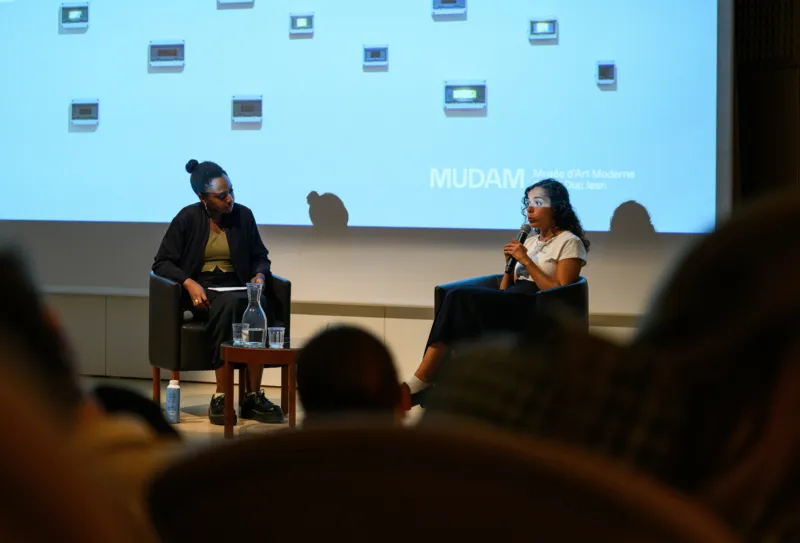
The conversation between artist Joyce Joumaa (b. 1998, Beirut, Lebanon) and curator Caroline Honorien is an edited version of an artist talk that took place at Mudam Luxembourg on 3 July 2026, on the occasion of the exhibition Video Killed the Radio Star: The 1980s and their Cultural Echoes (12 June–11 October 2026), in which Joumaa’s work is included. It was edited by Marie-Alix Isdahl.
Read more about Mudam Journal.