Made in Occupied Japan
BuBu de la Madeleine and Yoshiko Shimada speak with Yurika Imaseki about how art can confront silenced histories without fixing them into a single narrative.
Yurika Imaseki: I would love to learn how you two first met and how you began collaborating as artists.
Yoshiko Shimada: I met Teiji Furuhashi at the Age of Anxiety exhibition of contemporary Japanese art in Toronto in 1995 and he recommended that I meet BuBu. He passed away shortly afterwards and introducing us felt almost like his ‘last will and testament’.
After reading Giovanna Dalla Costa’s The Work of Love: Unpaid Housework, Poverty and Sexual Violence at the Dawn of the 21st Century (1978), I began to wonder why reproductive labour goes unpaid and how that connects to sex work. I invited BuBu to a talk at the How much is your Labour of Love exhibition at Ota Fine Arts in 1996, which led to further collaboration. Our perspectives on colonialism and feminism aligned from then on.
BuBu de la Madeleine: I have been engaged in sex work since 1992 and was actively building networks. However, there were very few people around me who truly understood the nature of sex work. I was surprised when I met Shimada-san and she casually said, ‘Sex is labour too.’ I felt a sense of relief – it was a joy to encounter someone who shared an understanding of this work, which I had previously found required extensive explanation.
YI: Shimada-san, you grew up in Tachikawa, near the military base. Could you tell us about the history of sex work in this area and how your personal geography shaped your interest in this subject?
YS: Although it wasn’t as prevalent as immediately after the war, there was still a great deal of sex work associated with military bases in the 1960s, when I was growing up. There were mixed-race Japanese-American children in each grade. In the late 1970s, when I was a high school student, I went to the US as an exchange student through a sister-city programme linked to Tachikawa Air Base. After I arrived, I sensed that Japanese women were still viewed as sex objects. Post-war US-Japan relations are therefore not merely a historical matter; they have become one of the elements that constitute who I am, in a deeply personal and physical way.
I wondered why reproductive labour goes unpaid, and I started thinking about how that connects to sex work.
YI: Around the mid-1990s, public discourse shifted significantly, with Prime Minister Murayama’s 1995 apology for Japan’s wartime aggression and his apology to former ‘comfort women’ – a euphemism for ‘military sex slaves’ – alongside a corresponding rise in backlash and denial.[1] How did these political developments affect your artistic concerns at the time?
YS: Kim Hak-soon began speaking out about her experiences as a ‘comfort woman’ in 1991, during the Miyazawa administration – a ‘dove’ administration within the Liberal Democratic Party. Following an investigation, Foreign Minister Kono issued the Kono Statement in 1993, acknowledging the Japanese military’s involvement in the sex slave trade in occupied territories. The year 1995 marked the 50th anniversary of Japan’s defeat in the Second World War, and war crimes were discussed and reflected upon relatively openly. I had, however, no intention of treating this as a mere ‘artistic concern’. I detest it when social events are used as ‘motifs’ in artworks. It was something I thought about daily, so expressing it felt natural.
YI: Could you tell us about the process of making the collaborative artwork Made in Occupied Japan (1998)?
BuBu: I received an invitation to collaborate through a letter. Since I had never made artwork before, there was the surprise of realising, ‘So this is how artworks are actually created.’ I had been involved in theatre and performances as part of a drama troupe, but I had no experience making pieces for exhibitions.
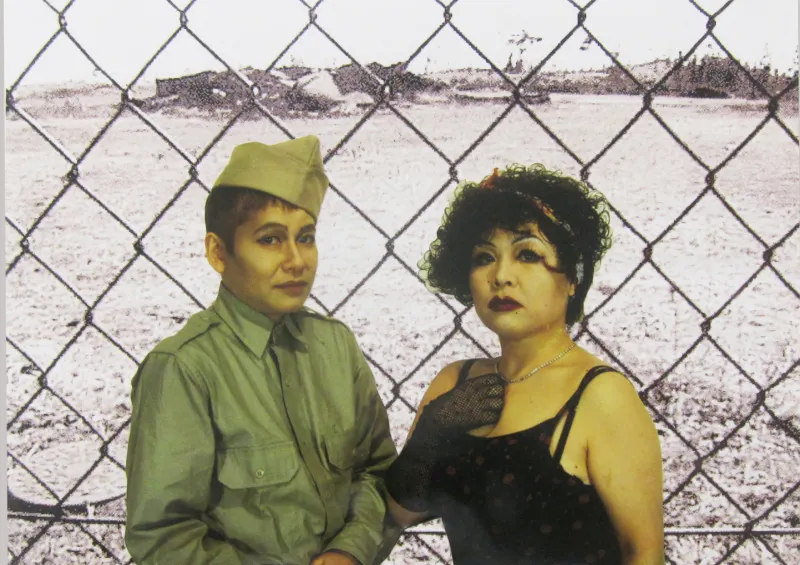
YS: I invited BuBu to Tokyo and we photographed at locations in Tachikawa where remnants of the military base still remained. The concept was to re-enact scenes from Tachikawa’s past, with me portraying an American soldier and BuBu a ‘pan-pan’ (sex worker). The shoot took place over several days. We also photographed at Ota Fine Arts, where BuBu portrayed the Emperor and I played MacArthur. Afterwards, I cut out the photographs and created a collage in my studio. For the video, I alternated the photographs with texts by BuBu to create a slideshow.
BuBu: As for the costumes and characters, I used things I already owned. Since I was working as a drag queen, choosing make-up and outfits that conveyed a character came quite naturally to me – the person I was playing was essentially myself.
YI: Could you tell us about the text that appears in the video, including this passage:
‘I want to tell you, those who were Pan-Pans, or those who are Pan-Pans.
There is nothing wrong with you.
What is necessary and how much of it is necessary to live can only be known to oneself.
[…]
I have a lot that I want to say.
But, do you understand what I want to say?’
BuBu: ‘To Women Under Occupation’ is a text inspired by my mother’s experiences in Nara just after Japan’s defeat. She witnessed and heard accounts about women engaging in sex work for US soldiers. Based on these stories, I depicted a ‘pan-pan’ with the messages ‘it wasn’t bad’ and ‘only you could decide what was needed at the time’ – recognising that selling sex was one option among many for obtaining cash and food when there was nothing to eat.
[1] During the wartime period, Japan expanded its territory as part of a process of imperial expansion that had begun in the Meiji era. Following the Manchurian Incident in 1931 and the establishment of Manchukuo, the Japanese military set up so-called ‘comfort stations’ across occupied territories, including Korea, China, Taiwan, the Philippines, Indonesia, Burma, Singapore, Malaysia and the Solomon Islands, where an estimated 200,000 women and girls were forced into sexual slavery between 1932 and 1945. In 1996, the United Nations referred to them as ‘military sexual slaves’. See Yoshiaki Yoshimi, Comfort Women: Sexual Slavery in the Japanese Military During World War II, trans. S. O’Brien (New York: Columbia University Press, 2000 [1995]).
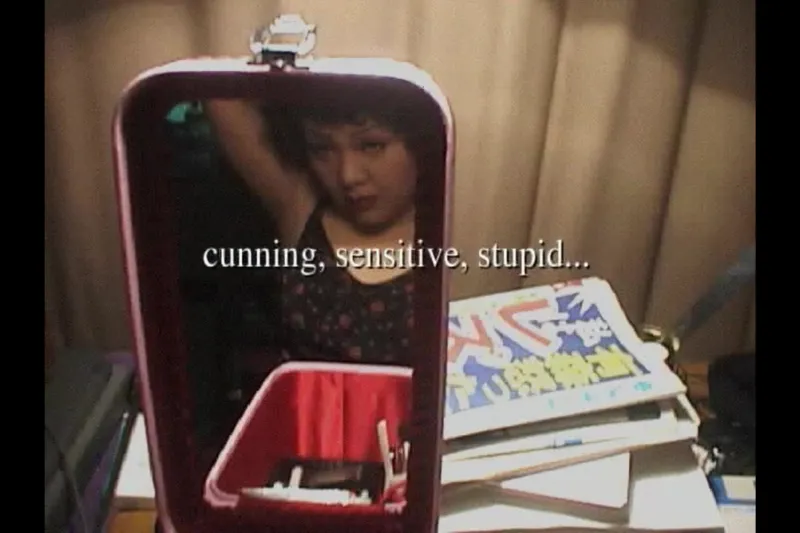
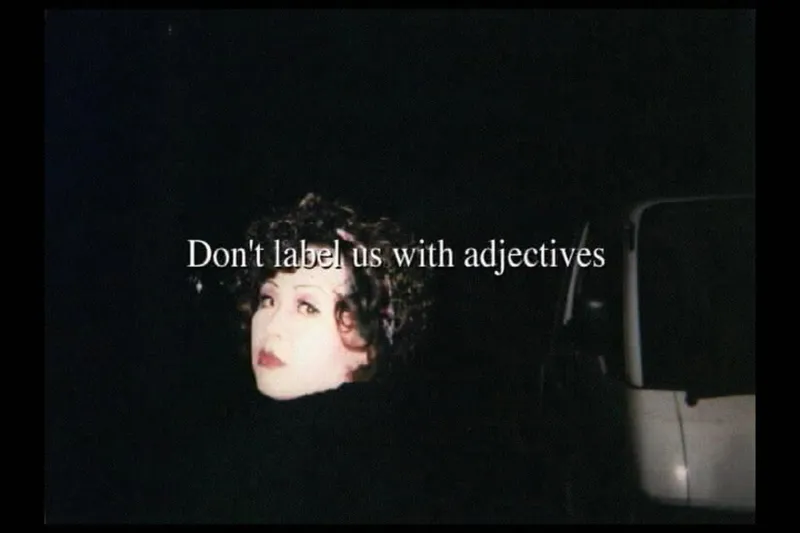
YI: How does Made in Occupied Japan address the risk of either romanticising or erasing occupation-era sex workers? Thinking through Gayatri Spivak’s ‘Can the Subaltern Speak?’ (1985), does BuBu-san’s text – ‘Please don’t put any adjectives to prostitutes … But, do you understand what I want to say?’ – point to both the silencing of the subaltern and the difficulty of hearing them on their own terms? And how do you expose such structures of silence without reproducing the forms of erasure or epistemic violence that the work critiques?
YS: As for the question of who can speak about what, it is said that ‘the act of speaking itself involves a form of interpretive violence’. In that sense, I believe the very act of creating a work of art can be violent. But if we avoid that violence altogether, does expression simply become muted, as with Faret Tachikawa,[2] an art project which erased the history of the former military base? Even the official History of Tachikawa City makes no mention of the ‘pan-pan’. That absence reflects discriminatory attitudes shaped by a patriarchal system extending from the pre-war period into the present. Some of the sex workers were certainly exploited and victimised, but I also believe that the ‘pan-pan’ contributed to Tachikawa’s post-war reconstruction. It is difficult to say how independent the sex workers were, but they had a certain degree of autonomy: some even formed a union. I wanted to make sure that aspect was represented as well.
BuBu: Something similar appears in Meiji Drag Anti-Imperial Sugoroku (2025). Even when we become American soldiers, ‘pan-pan’ or the Emperor, there is always a disjunction – a sense that the embodiment can never be complete. That gap itself contains a kind of violence. By deliberately embodying these figures, by attempting to become them, you leave room for viewers to fill in the gaps. I think that worked better than trying to express everything verbally. When we made Made in Occupied Japan, Shimada-san and I worked quite intuitively. There was a kind of intimacy between us. For me, it came from trusting someone who could say outright, ‘Sex is labour’, and feeling, ‘I can talk to this person.’
The question of being structurally deprived of a voice also made me think of Shimada-san’s series Bones in Tansu – Family Secrets, in which people confess things they cannot tell anyone: memories of the ‘pan-pan’, a soldier having killed someone, or smaller things marked by guilt or shame that remain difficult to speak about within the family. At the time, I felt the work distilled the reality of being deprived of language within the domestic sphere. It came from lived experience rather than imported Western philosophy.
YS: People tend to refer to ‘drag’ as ‘gender-bending’, but looking back, I realise it was something I created on a whim. Now, having gone through various experiences, including reading Spivak, I’m finally able to explain it, and I see that it is not simply about ‘gender-bending’. As for why I, a Japanese woman, became an American soldier: it is because the position of the ‘subject’ is not fixed. It is not simply that the oppressed lack agency because they are overwhelmed by those in power. The positions of victor and defeated, ruler and ruled, perpetrator and victim are not entirely stable. Through interpretation and appropriation, the relationship between them can become fluid rather than static. Yet when we try to represent or historicise that reality, we inevitably simplify it. My intention was to challenge the notion that the perpetrator occupies the position of the subject while the victim does not.
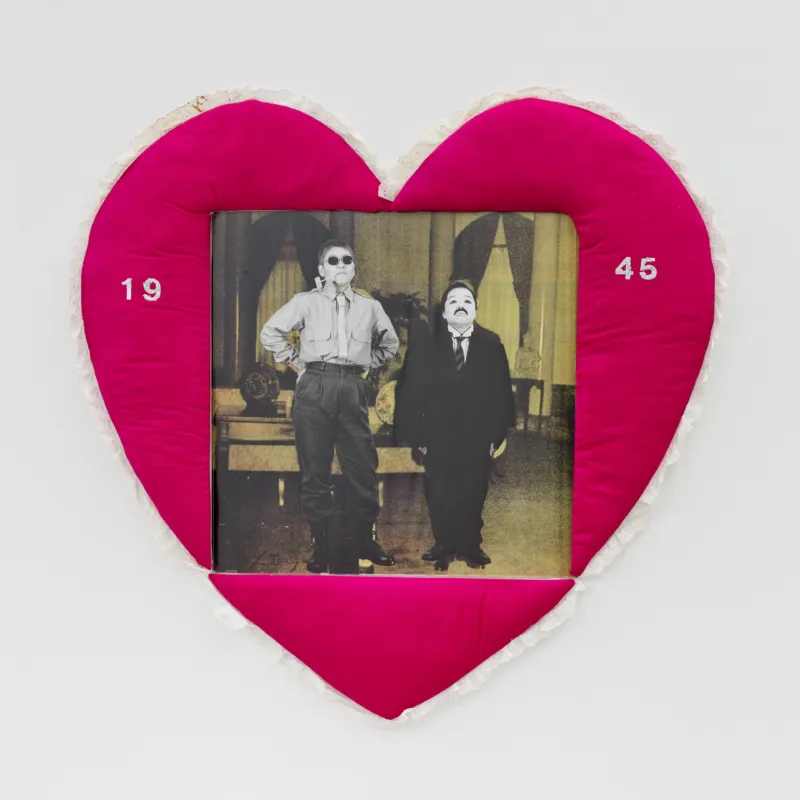
BuBu: That’s when reversal becomes accompanied by laughter. When a tough-looking man cross-dresses or gets high, there’s humour there. A little girl becoming a grown man just looks like a tiny man. But when Shimada-san became an American soldier, there was something very complex happening – uncertainty as to whether it was scary or not. Reversal particularly targets those in higher positions. When I became the Emperor or Shimada-san became MacArthur, the humour was crucial, something like a rebellious ‘I got you!’ feeling.
In Made in Occupied Japan, there’s a scene where I teach Japanese to Shimada-san, dressed as an American soldier – it’s ultimately comical. There was subtlety in that slightly awkward positioning of the terrifying figure labelled ‘American soldier’, sitting there primly, like a schoolboy being instructed. Not too exaggerated, right at the point where it becomes funny.
[2] Faret Tachikawa is a public art site built in 1994 on the site of a former US military base near Tachikawa Station and planned by Fram Kitagawa.
My art is concerned with the body, including sexuality. Some things can only be expressed through bodily experience.
YI: With your collaborative work being exhibited in Europe, how might the Western gaze directed at women of colour influence its interpretation?
YS: A German scholar who knows Japan quite well said of our work that ‘it shows how Japanese women are in a subordinate relationship to men’. That is an oversimplification and totally misses our point. Mainstream feminism strongly opposes sexual violence. I don’t want our works to be interpreted solely from a feminist perspective or through a framework that portrays women as perpetual victims of war. This is not about denying sexual violence, but about questioning the fixed positions of victim and perpetrator through which these histories are often understood. That’s why it is crucial to adopt a postcolonial perspective on who can speak and how. I want people to recognise the fluidity of gendered relationships, as well as the colonial situations that continue to this day.
BuBu: I recently learned the term ‘femonationalism’. In the West, politicians who emphasise sexual violence against women can also be those who discriminate against trans people and sex workers. There is a tendency to amplify certain voices around sexual violence in ways that can become exclusionary. What we realised in Europe was that it is not simply a question of West versus Asia; class divisions exist within every country and region. In Venice, for example, I witnessed Italian sex workers respond to discussions of sexual violence against women from a distinctly working-class perspective.
Sexual violence and immigration can also be exploited by nationalism. In Japan, there is increasingly a rhetoric of ‘protecting Japanese women’, which can become a pretext for xenophobia and for targeting trans women and sex workers. I want to disrupt that logic. Sexual violence is unacceptable, but we don’t want it to be used to justify nationalism or xenophobia.
I believe the very act of creating a work of art can be violent.
YI: The concept of kokutai (national body)[3] intersects with the Orientalised feminisation of Japan under US occupation. Does the work intervene in the way Japan’s imperial violence becomes obscured through its own narrative of victimhood?
YS: The Japanese Empire itself made use of this feminisation of kokutai. Although the Emperor commanded the military, he was presented as a more ‘maternal’ figure than the paternalistic Hitler or Mussolini. His subjects were regarded as the ‘Emperor’s children’, and he was associated with Amaterasu Ōmikami, a goddess. Even after the war, the Emperor was never held accountable for his role. The Imperial Rescript on the Termination of the War was interpreted as having ‘brought peace’, and he was recast as a symbol of ‘peace’. I think this narrative of the Emperor as both ‘feminine’ and a ‘victim’ helped distance him from responsibility. In turn, it also allowed the Japanese people to identify themselves with victimhood rather than with the violence of the empire.
BuBu: Exactly. Gender could be suspended or blurred in ways that granted impunity. That is also how I think about kokutai in relation to gender. Recently, Takanori Hayao, a scholar who writes about Palestine, argued that when Israeli forces kill, abuse or humiliate Palestinians, they also target the masculinity of male prisoners. By humiliating Palestinians specifically as men, the violence is directed not only at individuals but at forms of masculinity associated with the wider national community. Women are also subjected to humiliation, but the attack on male prisoners takes on a specifically gendered form.
In Japan, too, war and masculinity are rarely discussed together. Perhaps Japan’s difficulty in acknowledging and apologising for its invasion of Asia is also connected to ideals of masculine behaviour. For me, this is a question of both colonialism and gender. There seems to be very little space for men to admit vulnerability, or even to know how to do so. That inability can become burdensome and, ultimately, harmful.
[3] Kokutai is a Japanese term that translates as ‘national polity’ or ‘national body’. It refers to the fundamental political structure and sovereign identity of the Japanese state, encompassing both its legal-political framework and the perceived spiritual essence defining Japan’s nationhood. Historically, the concept emphasised the emperor’s claimed special status as a divine figure connecting gods and people, with bansei ikkei (‘unbroken imperial lineage’) serving as a spiritual and political foundation of the nation. This ideology became central to Japanese nationalism from the Meiji Restoration (1868) through the Second World War, when it was promoted by government authorities, including the Ministry of Education – most notably through the 1937 publication Kokutai no Hongi (‘Cardinal Principles of the National Body’).
It was my intention to break free from, or refute, the notion that the perpetrator is the subject while the victim is not.
YI: Your work avoids treating any single experience as definitive or universal, while still taking lived memory seriously. How do you narrate memory without absolutising experience or falling into essentialism? And what role can art play in confronting the past and connecting it to present concerns?
BuBu: My art is concerned with the body, including sexuality. Some things can only be expressed through bodily experience, and art can make those experiences perceptible to others. My work draws on what I have learned through experiences such as sex work, marriage, illness, disability and caring for my parents. Sexuality is one element among these because it is a universal aspect of human life; no one is entirely outside it.
At the same time, personal experience cannot be treated as absolute. There is always a danger in speaking for or representing someone else. In a global sex worker network, for example, connecting with individual sex workers can be empowering precisely because it allows different experiences to remain distinct.
YS: In Made in Occupied Japan, I juxtaposed military prostitution with contemporary sex work, but my intention was not simply to say that ‘past sex work and sexual violence are still happening today’. There are personal and regional memories involved, but the work is not based on my own experience. What I can do is not uncover past facts and turn them into a single narrative, but return to them, examine them repeatedly and express the complex relationships that emerge.
In Jacques Rancière’s Le Maître ignorant (1987), acquiring knowledge involves ‘observing carefully, committing to memory, and repeatedly verifying’. It means seeing what one has already seen anew, and continually reflecting on what one sees, what one thinks about it and what one does with it. For me, that is the role of art.
The conversation between artists BuBu de la Madeleine (b. 1961, Osaka, Japan) and Yoshiko Shimada (b. 1959, Tokyo, Japan), and independent curator and research associate Yurika Imaseki, took place on the occasion of their participation in the exhibition Kaihō – Japanese Women Artists after 1945 at Mudam Luxembourg (25 September 2026 – 14 February 2027). The conversation is published for the first time in Mudam Journal.
Edited by Gabriela Acha, Olivier Hoffmann and Marie-Alix Isdahl, Mudam Journal provides a space for exploration, artist-led perspectives and critical thinking beyond the exhibition.
Read more about Mudam Journal.