Michel Majerus
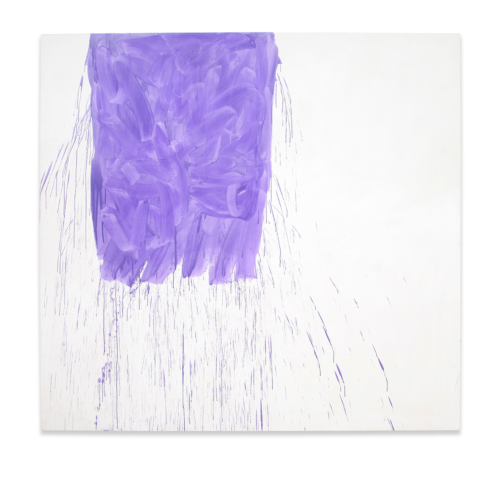
Untitled (Violet) (1997) by Michel Majerus (b. 1967, Luxembourg – d. 2002, Niederanven) is a non-figurative, gestural work that appears initially to refer to the language of abstract expressionism. Yet the area of pictorial action is confined to the upper left corner of the canvas, drawing attention to the splashes of paint, and revealing the process of painting. The ‘splash’ motif, which is recurrent in Majerus’ work, alludes to the frantic pace of our modern world and to the pace of visual acceleration in the information age.
Despite the brevity of his career, Majerus built an international reputation, becoming renowned for his large- format paintings that draw upon the colourful iconography of advertising, comic strips and digital art, along with the vocabulary of Pop Art and gestural abstraction. This piece, which is deceptively impulsive in appearance, is the result of a carefully thought out and premeditated execution. What Majerus presents with irony to the viewer is not an abstract painting but the image of an abstract painting, in which spontaneity is staged.
Artworks

![]()
Michel Majerus Untiled 5, Untitled 39, 1996 Acrylique sur toile
60 x 60 cm chacune
Collection Mudam Luxembourg
Donation 2022 – American Friends of Mudam, Collection Raymond J. Learsy
© Photo : Rémi Villaggi / Mudam Luxembourg
© Michel Majerus Estate, 2022
![]()
Michel Majerus Untitled (Violet), 1997 Peinture acrylique sur toile
300 x 320 cm
Collection Mudam Luxembourg
Donation 2006 - Les Amis des Musées d’Art et d’Histoire Luxembourg
© Photo : Jens Ziehe, Berlin
© Michel Majerus Estate, 2022
![Michel Majerus, "SINNMASCHINE", 1997. Acrylique et crayon sur toile, plancher métallique industriel. 490,5 x 680 x 680 cm. Collection Mudam Luxembourg. Acquisition 2023 – avec le soutien des membres du Cercle des collectionneurs du Mudam Luxembourg. Vue de l’exposition "Michel Majerus. SINNMASCHINE", 31.03.2023 – 01.10.2023, Mudam Luxembourg © Photo : Mareike Tocha | Mudam Luxembourg]()
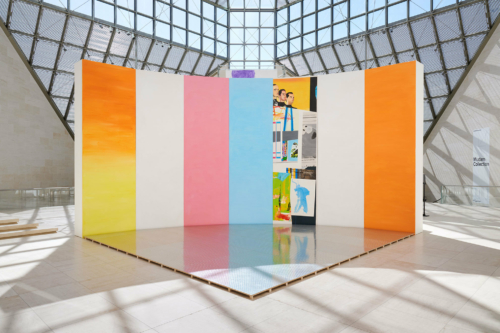
Michel Majerus SINNMASCHINE, 1997 Acrylique et crayon sur toile, plancher métallique industriel
490,5 x 680 x 680 cm
Collection Mudam Luxembourg
Acquisition 2023 – avec le soutien des membres du Cercle des collectionneurs du Mudam Luxembourg
Vue de l’exposition Michel Majerus. SINNMASCHINE, 31.03.2023 – 01.10.2023, Mudam Luxembourg
© Photo : Mareike Tocha | Mudam Luxembourg

![]()
Michel Majerus Running in Cycles, 2001 Sérigraphie couleur sur PVC
500 x 750 cm
Collection Mudam Luxembourg
Acquisition 2002
© Photo : Jens Ziehe, Berlin
© Michel Majerus Estate, 2022

![]()
Michel Majerus Halbzeit, 2002 Acrylique sur toile
220 x 200 cm
Collection Mudam Luxembourg
Acquisition 2002
© Photo : Galerie Max Hetzler
© Michel Majerus Estate, 2022
